No-Tent Spot Treatment Service
At Licensed Termite Control Company, no-tent spot treatment eliminates drywood termite colonies without tenting your home, without fumigation, and without asking you to leave for 2 to 3 days. You stay home. Your family routine continues. The treatment targets the exact wood cavity where termites are living and eliminates the colony inside. For most Sacramento homeowners with isolated dry-wood termite infestations, spot treatment is the most practical and cost-effective solution available.
How Spot Treatment Locates and Eliminates Drywood Termite Colonies
Finding the colony is the most critical step in spot treatment. Injecting termiticide into the wrong area wastes money and leaves the infestation alive. We use three detection tools before any drilling begins.
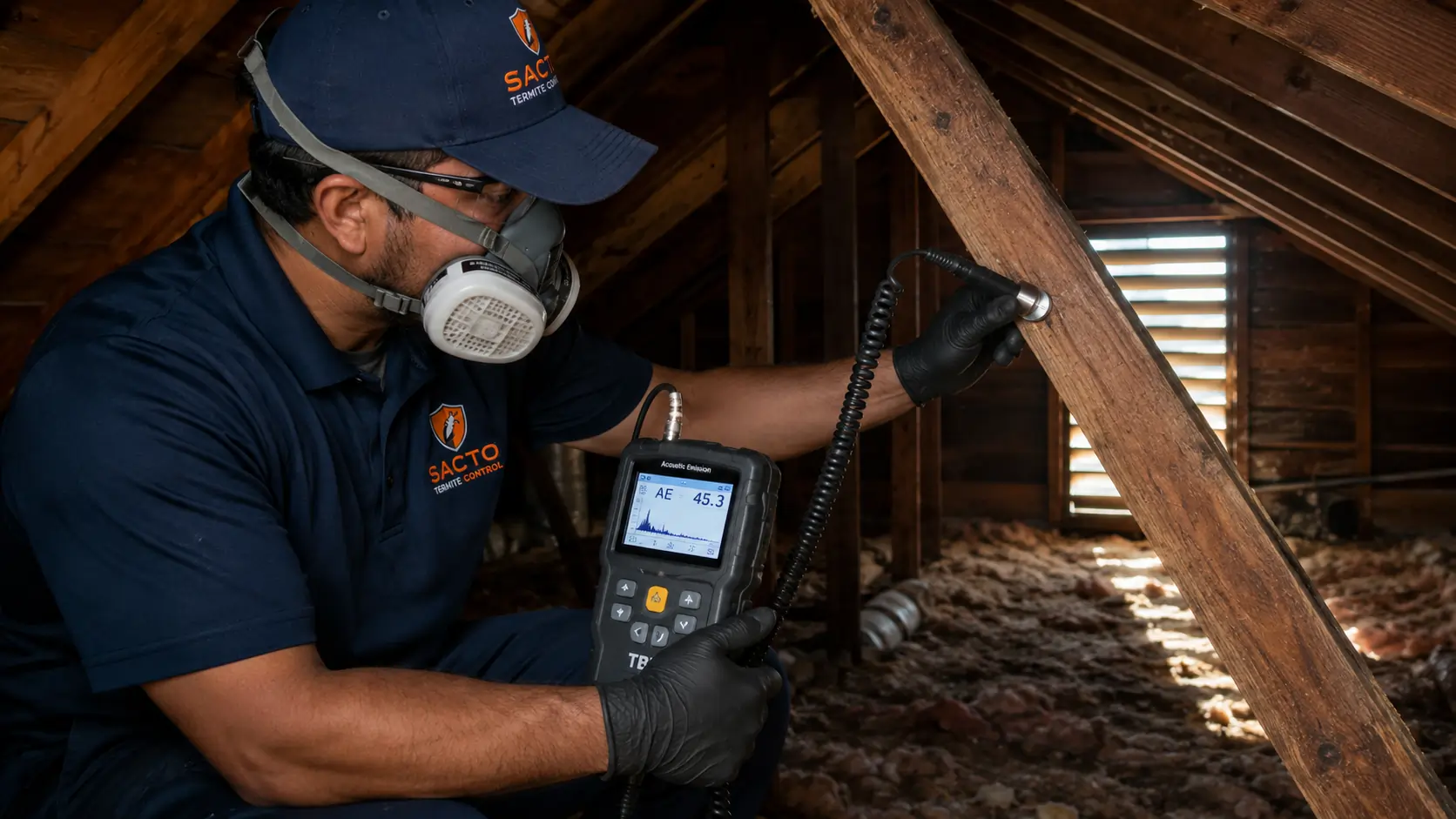
An acoustic emission device listens for termite feeding activity inside wood. Termites produce distinct vibration signatures as they chew through wood fibers. The device detects these signatures through the wood surface without opening the wall or ceiling. This tells us exactly which boards are actively infested and which are not. Thermal imaging identifies temperature variations inside walls and ceilings where colony activity generates slight heat differences. A probe tool confirms wood integrity by testing surface resistance, as hollow galleries feel different from solid wood under pressure.
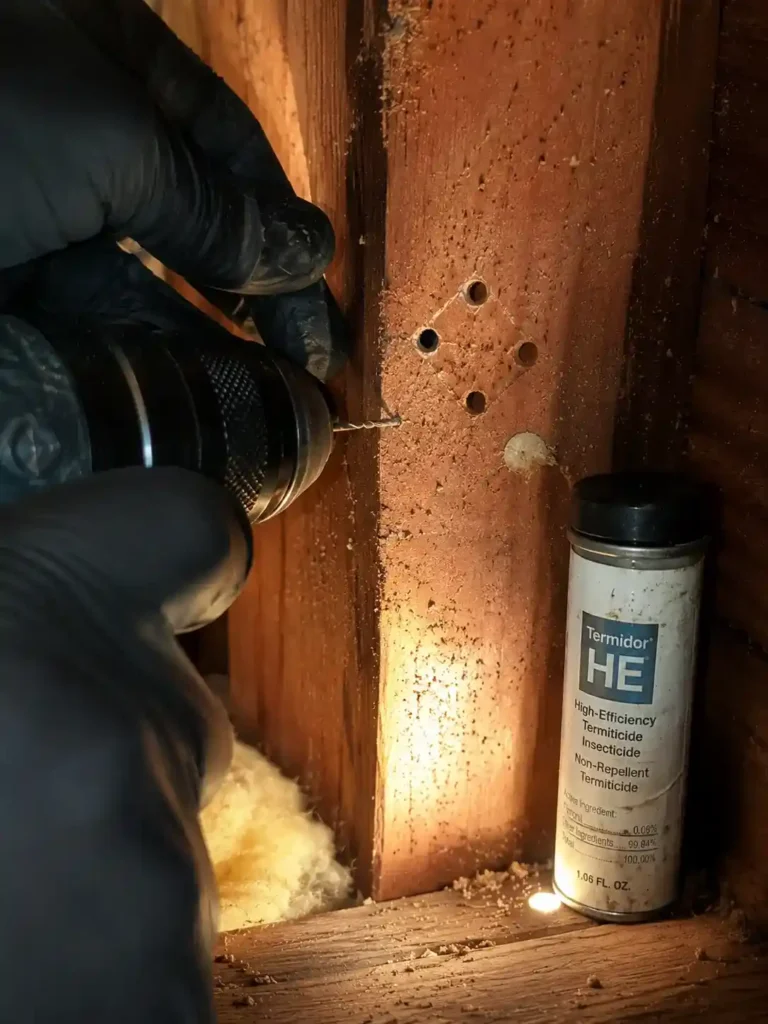
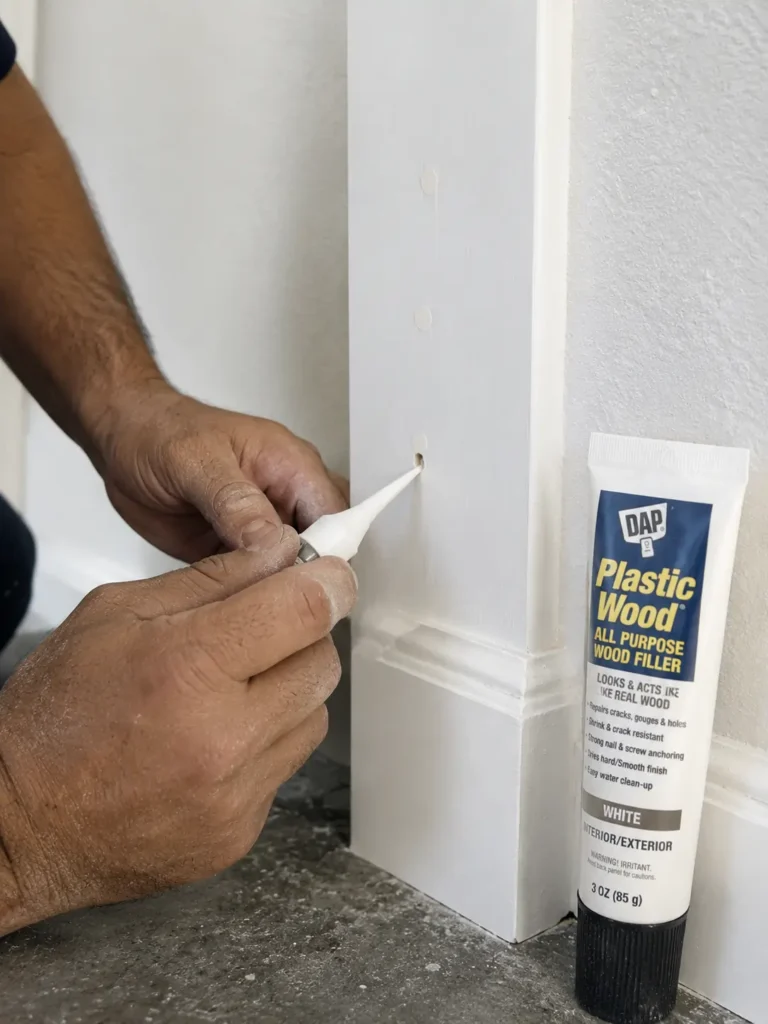
Once the infested wood cavity is confirmed, we drill 1/8-inch holes in a diamond pattern spaced 3 to 5 inches apart along the length of the affected board. This protocol follows the injection methodology validated in a 2009 field study conducted by the University of California and the California Structural Pest Control Board, which tested six commercial termiticides applied to western dry-wood termite-infested structural lumber. We then inject termiticide through each hole directly into the gallery. The termiticide contacts and kills all termites inside that cavity. After injection, every hole is sealed with a wood plug or filler. On painted or finished surfaces, the sealed holes are nearly invisible after touching up with matching paint.
The termiticide we use depends on the location and wood type. For accessible framing and structural wood, fipronil-based foam products distribute through the gallery and kill on contact. For wood that will remain in place long-term, borate-based treatments like Bora-Care are an option. Bora-Care uses glycol penetrants to diffuse disodium octaborate through the wood. Once in the wood, it remains there for the life of the structure. It kills active termites and prevents future colonization of that wood member.
When Spot Treatment Works and When Fumigation Is the Right Choice
Spot treatment is effective for isolated, accessible infestations. It is not the right tool for every drywood termite situation, and being honest about that distinction protects homeowners from paying for treatments that will not solve their problem.
Spot treatment works when the infestation is confined to one or two identified locations, when the infested wood is accessible for drilling and injection, and when acoustic emission and thermal imaging confirm no activity in other areas of the home. A home with one infested attic rafter and no evidence elsewhere is an ideal spot treatment candidate. You get targeted colony elimination without the disruption or cost of tent fumigation.
Spot treatment is not sufficient when drywood termites are active in four or more separate locations, when infested wood is sealed behind finished walls with no accessible drilling surface, when a termite inspection finds evidence in multiple stories or multiple rooms, or when a previous spot treatment did not resolve the infestation. In those cases, whole-structure fumigation provides the certainty that localized treatment cannot. We will tell you which situation you are in after inspection, before recommending a method.
A note on orange oil treatments: orange oil containing d-limonene kills drywood termites on direct contact. It has no residual effect inside the gallery and does not eliminate colony members it does not directly touch. Research from the UC Riverside Urban Pest Management Center confirms that orange oil functions as a contact killer, not a colony management tool. It does not transfer through termite social behavior the way systemic termiticides do. We do not use orange oil as a primary spot treatment method because the colony survival rate after treatment is higher than with systemic products.
For commercial properties including offices, retail spaces, and historic buildings with original wood framing, spot treatment follows the same protocol but may involve more access points and a longer treatment session. We coordinate with property managers to schedule treatment with minimal disruption to daily operations.
What Sacramento Homeowners Say About Our No-Tent Spot Treatment
Verified feedback from residential and commercial clients across our service area.
We had drywood termites in a bedroom wall and absolutely could not leave the house with a newborn. The inspector confirmed the infestation was in one location, used thermal imaging to pinpoint it, and completed spot treatment in under two hours. We stayed home the entire time. The injection holes were patched and painted before they left.
Found frass on the windowsill of my home office. The inspector found an active drywood colony inside the window frame using acoustic detection, treated it the same day, and sealed the entry points on the exterior. Total time on site was about 90 minutes. No disruption to my work and no need to vacate the property.
What to Expect During and After Spot Treatment
Spot treatment is one of the least disruptive termite treatments available. You do not need to vacate, bag food, remove plants, or board pets.
On treatment day, our technician arrives with detection equipment and injection tools. The inspection phase confirms which areas are active and which are clear. This takes 30 to 60 minutes depending on the home's size and the number of suspected locations. Drilling and injection for each colony location takes 15 to 30 minutes. For a home with two to three isolated colonies, the entire treatment session typically takes 2 to 4 hours. You can remain in any part of the home not being actively treated. There is no odor, no gas, and no chemical exposure in your living space.
After treatment, we seal all drill holes and touch up any visible marks. We provide a written treatment record documenting what was found, what was injected, where, and at what volume. This record is part of your home's pest control history and is useful for future inspections and real estate transactions.
A follow-up inspection 6 to 12 months after spot treatment confirms the treated colonies have been eliminated and that no new drywood termite activity has appeared. If termite damage repair is needed after treatment, repairs are scheduled once treatment is confirmed complete.
Frequent Questions About No-Tent Termite Treatment in Sacramento
Straight answers to what Sacramento homeowners ask most before calling us.
This is the right question to ask before choosing spot treatment. We use acoustic emission devices and thermal imaging to locate active colonies before treating. These tools are significantly more accurate than visual inspection alone. However, colonies hidden behind drywall in sealed wall assemblies where no drilling access is possible cannot be confirmed or treated through spot treatment. We document which areas were tested, which showed activity, and which were inaccessible. If inaccessible active areas are detected, we discuss whether fumigation is the more complete solution. Transparency about detection limits is part of our service.
In most cases, no. Holes are 1/8 inch in diameter. We seal them with a wood plug or wood filler immediately after injection. On painted surfaces, a single touch-up coat makes them nearly invisible. On natural wood trim or exposed beams, we use filler matched to the wood tone. The holes are smaller than a standard finishing nail and leave no structural mark. If you have a visible area of concern such as decorative trim, exposed ceiling beams, or hardwood flooring, tell us before treatment and we will plan the injection approach to minimize cosmetic impact.
Yes, in most cases. Spot treatment does not require evacuation, ventilation periods, or chemical exposure in occupied spaces. We can treat an infested wall cavity or ceiling area in a commercial office, retail space, or restaurant with minimal disruption to staff and customers. Work is confined to the specific injection area. We coordinate with your manager to schedule treatment during low-traffic periods when preferred. Written treatment documentation for commercial accounts is provided the same day.
Most no-tent companies in Sacramento use orange oil (XT-2000 Orange Oil Plus) as their primary product. Orange oil kills termites on direct contact but has no residual effect and does not transfer through termite social behavior. It cannot eliminate colony members it does not physically reach. We use systemic termiticides that spread through termite contact and feeding behavior inside the gallery, achieving higher colony mortality rates. We also use acoustic emission detection and thermal imaging that most orange oil-focused companies do not employ. If you have received a no-tent quote using orange oil, ask the company what their re-treatment rate is for treated locations within 12 months.
We Provide No-Tent Spot Treatment Throughout Sacramento and the Region
Our no-tent spot treatment services cover Sacramento, Elk Grove, Roseville, Folsom, Citrus Heights, Rancho Cordova, Carmichael, Fair Oaks, Rocklin, Davis, West Sacramento, Natomas, Galt, Woodland, Lincoln, Antelope, Orangevale, and Auburn.
Schedule an Urgent Inspection
Call (916) 269-0582 or email hello@sactotermitecontrol.com. We confirm the infestation with detection equipment before recommending treatment. Estimates are no-cost after inspection. Most spot treatments can be scheduled within the same week.
- Licensed by the California Structural Pest Control Board
- Acoustic emission detection and thermal imaging on every assessment
- Systemic termiticides, not contact-kill orange oil
- Written treatment record provided on every job
- Residential and commercial properties served