What Termite Droppings (Frass) Actually Look Like, and Why It Matters
Small, gritty piles near wood in your home are not always sawdust. Tiny pellets shaped like grains of pepper or sand are often frass, the droppings drywood termites push out of their tunnels. Learning to spot real frass helps you catch damage early, before it spreads through the wood. If you spot piles like these, Certified Termite Inspection Company in Sacramento can confirm what you are dealing with.

Frass Turns Up in Older Wood Across Citrus Heights, Rancho Cordova, Carmichael, and Fair Oaks
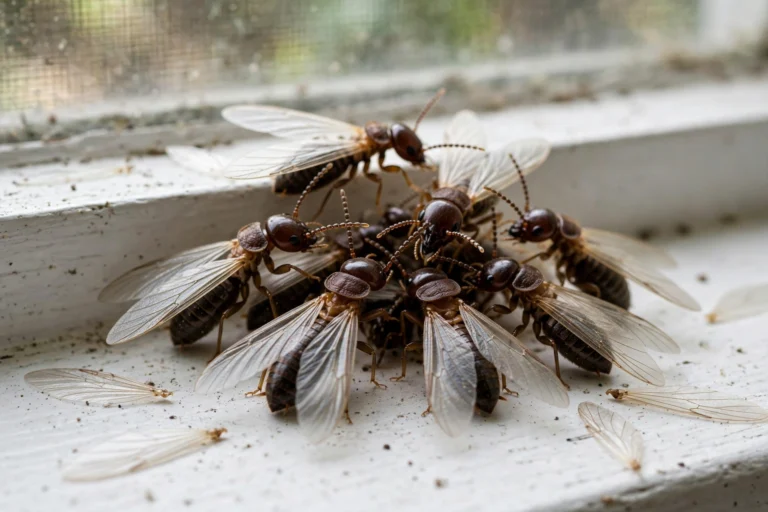
Drywood termites live inside the wood they eat, not in the soil. As they tunnel, they push their droppings out through tiny “kick-out holes” in the wood surface. The droppings, called frass, look like small, six-sided pellets. They are usually tan, brown, or black, and they pile up in a neat mound below the hole, almost like ground coffee or fine sand.
Frass is easy to confuse with sawdust from wood-boring beetles or plain dust from an old drill hole. Real sawdust looks like ragged shavings with no clear shape. Frass pellets are small, uniform, and hard, almost like tiny grains of rice cut short. If every pellet in the pile looks the same, you are likely looking at frass, not sawdust.
We see this most often in older homes across Citrus Heights, Rancho Cordova, Carmichael, and Fair Oaks, where original wood trim, attic framing, and fence posts have had decades to attract drywood termite colonies. If you find a pile of pellets on a windowsill, in an attic, or near a wood fence in any of these areas, a free termite inspection will confirm what you are dealing with.
We offer same-day and next-day termite inspections across the Sacramento Valley, and every inspection ends with a clear answer on what is producing the frass you found. If nothing is active yet, we can also set you up on an annual termite bond so a small pile of pellets never turns into a bigger problem.


Drag the divider, or tap anywhere on the photo, to compare sawdust and termite frass.
How We Confirm Drywood Termite Activity From a Frass Sample
When you find frass, our inspectors do not guess. We collect a sample and check the pellet shape closely, since frass shape differs slightly between drywood termite species. We also check the surrounding wood for kick-out holes, hollow sections, and blistered paint, which are all signs of an active gallery hidden behind the surface.
Once we confirm drywood termite activity, we walk you through the right next step. That might be a full drywood termite control treatment for a widespread colony, or a smaller spot treatment for one isolated area. Every plan starts with the inspection, never with a guess based on the frass alone.
Frequent Questions About Termite Frass
Straight answers to what Sacramento Valley homeowners ask most after finding a pile of pellets.
Not always. Frass can be old if the pile has not grown or changed in weeks, since a colony can move on or die off. Fresh, light-colored pellets that keep reappearing after cleaning are the strongest sign a colony is still active inside the wood.
Cleaning up a small pile is fine for now, but do not seal or paint over the kick-out hole first. Note where you found it and how quickly it comes back. A fresh pile within a few days of cleaning is a clear sign the colony is still active and worth a professional look.
No. Frass is not toxic and will not make you or your pets sick. It is simply digested wood, so it is safe to sweep up, though a dust mask is a fine precaution if you would rather not breathe in the fine particles.
Yes. Offices, warehouses, and retail buildings in the Sacramento Valley use the same wood framing and trim that attract drywood termites, so a frass pile in a commercial space gets the same close inspection as one found in a house.