
· Elk Grove – Zone 1 · Cosumnes River Basin
Control Termites in Elk Grove, CA – Before It Costs More.
Elk Grove’s Vertisol clay soils and proximity to the Cosumnes River corridor create persistent subterranean termite pressure across the city’s residential neighborhoods. Our licensed technicians have protected Elk Grove homes from subterranean, drywood, and Formosan termite species since 2010. Free inspections, same-day availability, and a written warranty on every treatment.
Open Today
15+
Years of Treating Termites
4.9★
Google Rating
24/7
Emergency Service

Complete Termite Control in Elk Grove Across Every Species, Property Type, and Treatment Stage
Elk Grove’s Vertisol clay soils, Cosumnes River floodplain, and agricultural land boundaries create one of the most sustained subterranean termite environments in the Sacramento Valley. Protecting an Elk Grove property requires matching treatment to the specific soil conditions, home age, and species pressure present at that address, not applying a standard protocol across a city where risk factors vary significantly by neighborhood.
Every Elk Grove engagement starts with a termite inspection using acoustic emission devices and thermal imaging to identify active species and locate colony positions before any treatment decision is made. Subterranean termites, which dominate Elk Grove’s clay lowland corridors, are controlled through liquid barrier applications calibrated for Vertisol soil, where standard barrier depth is often insufficient and crack injection is required alongside perimeter trenching. Drywood termites enter Elk Grove’s tile-roofed master-planned communities through ridge vents and hip cap gaps during the August-September swarming window and are addressed through targeted spot injection for contained infestations or whole-structure fumigation when colonies have spread across multiple attic zones.
Where Formosan subterranean termites are confirmed, a multi-method protocol combining liquid barriers and bait stations with extended monitoring is applied. Formosan colonies in Elk Grove’s floodplain-adjacent soil require more aggressive treatment than standard subterranean control. Homes in Laguna West, Stonelake, Elk Grove Village, and surrounding master-planned developments with original pre-construction barriers now 15 to 30 years old benefit from annual termite bonds covering inspection, barrier refresh, and retreatment guarantees. New construction in Elk Grove’s expanding western corridors receives pre-construction soil and framing treatment with full HUD-NPMA documentation for federally financed projects. Where termite damage has already occurred, we coordinate licensed contractor repairs covering structural sistering, sill plate replacement, and cosmetic restoration, with all building permits handled through Sacramento County.
Why Elk Grove Properties Face Termite Challenges
Elk Grove’s position at the junction of agricultural land, a major river floodplain, and rapid residential expansion created termite risk conditions that are more varied and persistent than most surrounding cities. These are the four problem patterns our technicians encounter most consistently across Elk Grove properties.
Agricultural Soil Borders Push Untreated Colonies Toward Foundations
WHY IT HAPPENS HERE
Undisturbed farmland surrounding Elk Grove’s residential edge contains large subterranean termite colonies that are never treated or disrupted. As residential development expands into agricultural land, displaced colonies migrate toward the nearest available wood source along the property boundary.
OUR APPROACH
Properties bordering farmland, retention basins, or open space are treated as permanently elevated-risk. A one-time barrier is not sufficient on these lots. We recommend annual inspection and barrier refresh as standard protocol, not optional maintenance.
Vertisol Clay Cracks Bypass Surface Barriers Entirely
WHY IT HAPPENS HERE
Elk Grove’s Vertisol clay is among the most expansive soil in the Sacramento Valley. It cracks up to 18 inches deep during dry summers, creating vertical termite pathways that circumvent perimeter barriers applied only at the soil surface.
OUR APPROACH
Crack injection is part of every Elk Grove treatment for properties with visible surface cracking near the foundation. We inject termiticide directly into active cracks before perimeter application to close pathways that standard trenching cannot reach.
Cosumnes River Floodplain Sustains Colonies Through Dry Season
WHY IT HAPPENS HERE
The Cosumnes River maintains elevated soil moisture in Elk Grove’s southern and eastern corridors year-round, including during summer months when surrounding clay desiccates. Subterranean colonies in floodplain-adjacent soil remain active regardless of seasonal conditions.
OUR APPROACH
Floodplain-adjacent properties require deeper barrier application and more frequent monitoring intervals than standard Elk Grove properties. We assess river corridor proximity at every inspection and adjust treatment depth and inspection schedule accordingly.
Degraded Barriers in 1990s–2000s Master-Planned Communities
WHY IT HAPPENS HERE
Pre-construction soil treatment applied in Laguna West, Stonelake, and Elk Grove Village during the 1990s and 2000s has now exceeded its effective lifespan. Chemical barriers from that era are at or below concentrations that block subterranean termite movement.
OUR APPROACH
We assess original treatment documentation where available and conduct soil moisture mapping at the foundation perimeter. Homes with no verified treatment in the past 10 years receive a full perimeter application as if no prior barrier exists.
Elk Grove Termite Activity Across Every Season
Elk Grove termite activity does not follow a single seasonal pattern. Soil type, river proximity, and agricultural land adjacency each drive distinct pest behavior at different points in the year.
Spring (March – May)
The Cosumnes River floodplain reaches peak saturation from March through May as Sierra Nevada snowmelt reaches the valley floor, triggering subterranean swarming activity in Elk Grove’s southern neighborhoods earlier than in surrounding cities. Winged reproductives from floodplain colonies disperse toward residential foundations during warm afternoons throughout this window.
TIP: Homes south of Elk Grove Boulevard and east of Big Horn Boulevard should schedule spring inspections before April 1. Floodplain moisture peaks earlier in Elk Grove than in Sacramento, and colony establishment begins while surrounding soil still feels cool to the touch.
Summer (June – September)
Elk Grove’s extreme summer heat cracks Vertisol clay deeply across the city while drywood termite swarmers exploit tile roof gaps and ridge vents common in Elk Grove’s master-planned communities from August through September.
TIP: Tile roofs create multiple swarmer entry points that composition shingle roofs do not. A late-summer attic inspection targeting ridge vent and hip cap gaps is recommended for every tile-roofed Elk Grove home before the swarming window closes.
Fall (October – November)
Agricultural harvest across Elk Grove’s southern and eastern farmland disturbs soil and displaces subterranean colonies that had established in field boundaries, pushing termite pressure toward the residential edge of the city as harvest activity progresses.
TIP: If your property backs up to recently harvested farmland or a cleared field, schedule a fall inspection after October 1. Soil disturbance from harvest is the single most reliable predictor of increased termite pressure at Elk Grove’s agricultural boundary.
Winter (December – February)
Elk Grove’s dense Vertisol clay absorbs winter rainfall quickly and drains slowly, saturating floodplain-adjacent soils rapidly and sustaining subterranean colony activity near the Cosumnes corridor throughout the wet season.
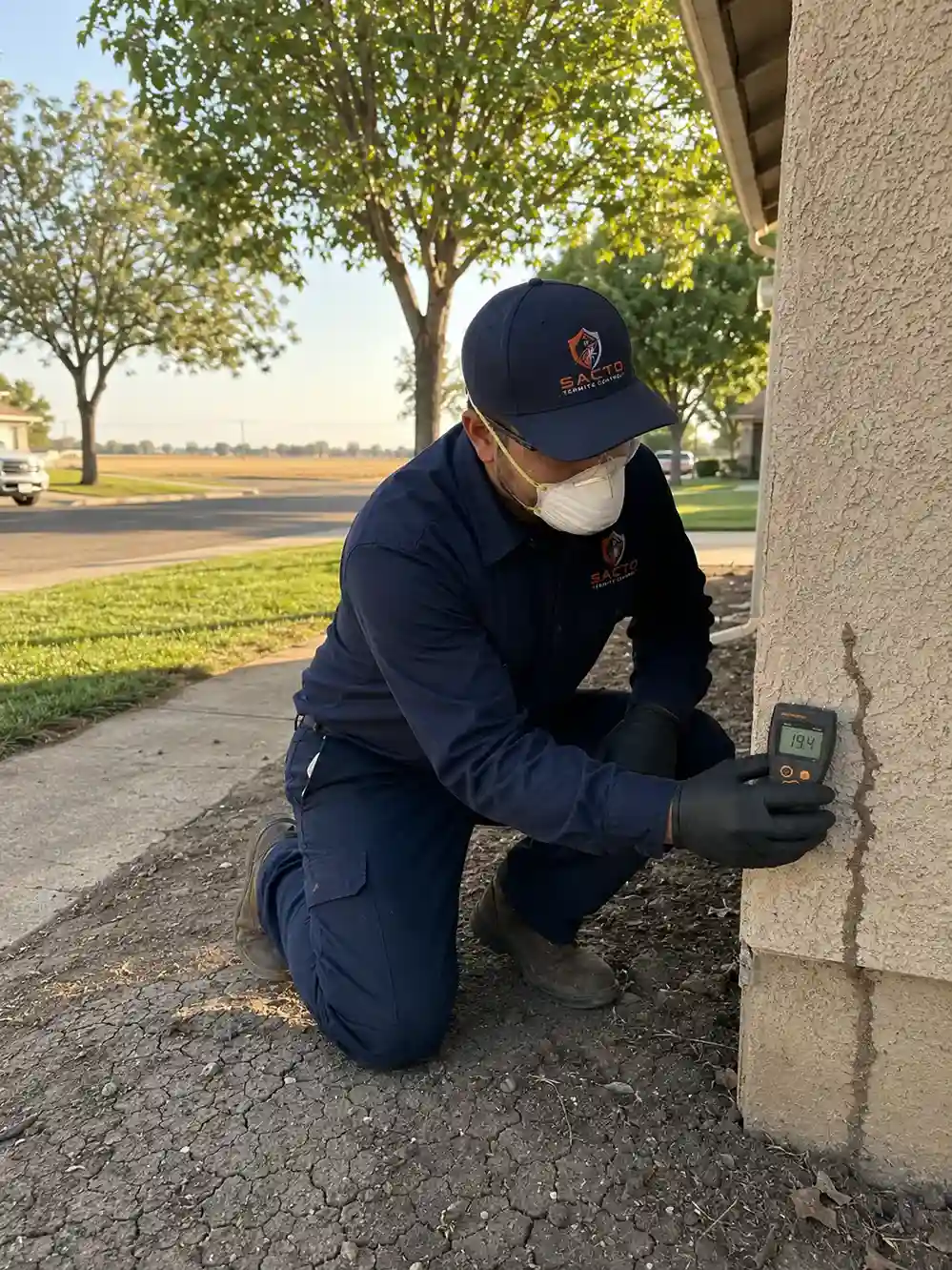
TIP: Check your foundation perimeter after each significant rain event between December and February. New mud tube construction on wet stucco and concrete foundation surfaces is most visible in the 24 hours immediately after rain clears.
Termite Control Services Available in Elk Grove
- Termite Damage Repair Structural and cosmetic repair coordination after treatment is complete. Licensed contractors, building permits handled, written repair estimates provided before work begins.
- Termite Inspection Same-day and next-day availability throughout Elk Grove. Acoustic emission detection and thermal imaging on every assessment.
- Termite Treatment Treatment matched to the species and severity found in your Elk Grove home. No upselling to methods the situation does not require.
- Subterranean Termite Control Liquid barriers and bait stations engineered for Elk Grove’s Vertisol clay soil conditions. The most common infestation type in the city, addressed with the right depth and volume.
- Drywood Termite Control Spot treatment for isolated drywood colonies or whole-structure fumigation for widespread infestations. Honest assessment of which method your situation actually requires.
- Formosan Termite Control Aggressive multi-method treatment for the most destructive termite species documented in Sacramento County. Formosan infestations in Elk Grove require faster action than standard subterranean cases.
- Tent Fumigation Whole-structure elimination for severe drywood infestations throughout your Elk Grove home. Complete in 48 hours with a clearance certificate before re-entry.
- No-Tent Spot Treatment Targeted termiticide injection for isolated drywood colonies without fumigation or evacuation. You stay home and the colony is eliminated.
- Pre-Construction Termite Treatment Soil and framing wood treatment for new Elk Grove builds before construction closes access. Essential in Elk Grove’s Vertisol clay where standard barriers require correct depth and volume to hold.
Termite Control Across Elk Grove and the Surrounding Sacramento Region
We serve Elk Grove-95624 and 17 cities throughout the Sacramento Valley. Every location receives the same licensed inspection standards and species-matched treatments.
Sacramento · Roseville · Folsom · Citrus Heights · Rancho Cordova · Carmichael · Fair Oaks · Rocklin · Davis · West Sacramento · Natomas · Galt · Woodland · Lincoln · Antelope · Orangevale · Auburn