
Pre-Construction Termite Treatment Sacramento
At Licensed Termite Control Company, we partner with Sacramento-area builders and homeowners to apply termite protection before construction closes off access to the soil and framing beneath your home. Pre-construction termite treatment is the most effective and least expensive point in a building’s life to prevent subterranean termite infestation. Once the concrete slab is poured, that window closes permanently. What costs $500 to $1,500 before the pour can cost $10,000 or more to retrofit after the home is occupied.
The Treatment Window, the Build Sequence, and What Happens if It Is Missed
Timing determines everything in pre-construction termite treatment. The treatment must be applied at the right stage of construction or it cannot be applied at all without major disruption later.
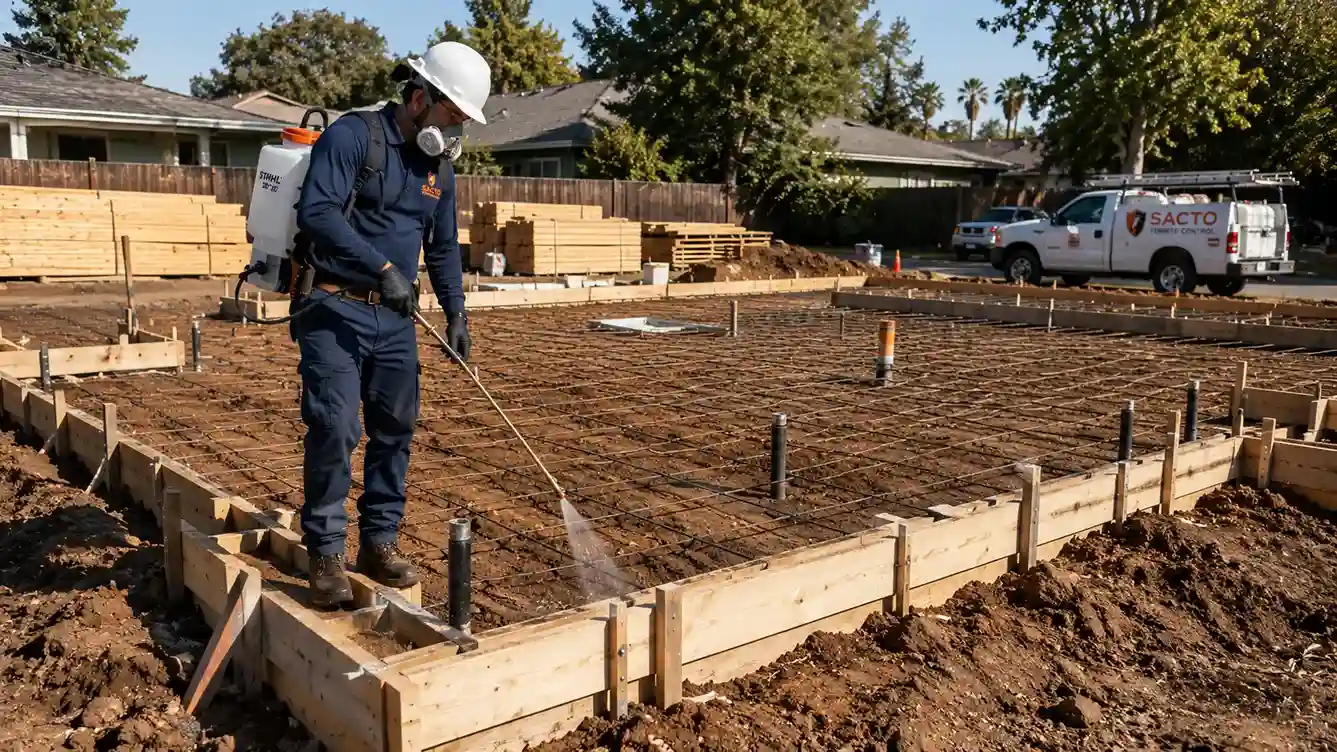
The correct sequence follows the foundation work. After footings are dug and forms are set, but before concrete is poured, the soil beneath the slab and around all utility penetrations is treated with a liquid termiticide. This creates a continuous chemical barrier in the soil that subterranean termites cannot cross to reach the wood framing above. California state law requires all construction activity on the site to stop during soil termiticide application. No other trades can be working during treatment. This is why coordination with the general contractor and all subcontractors must happen in advance.
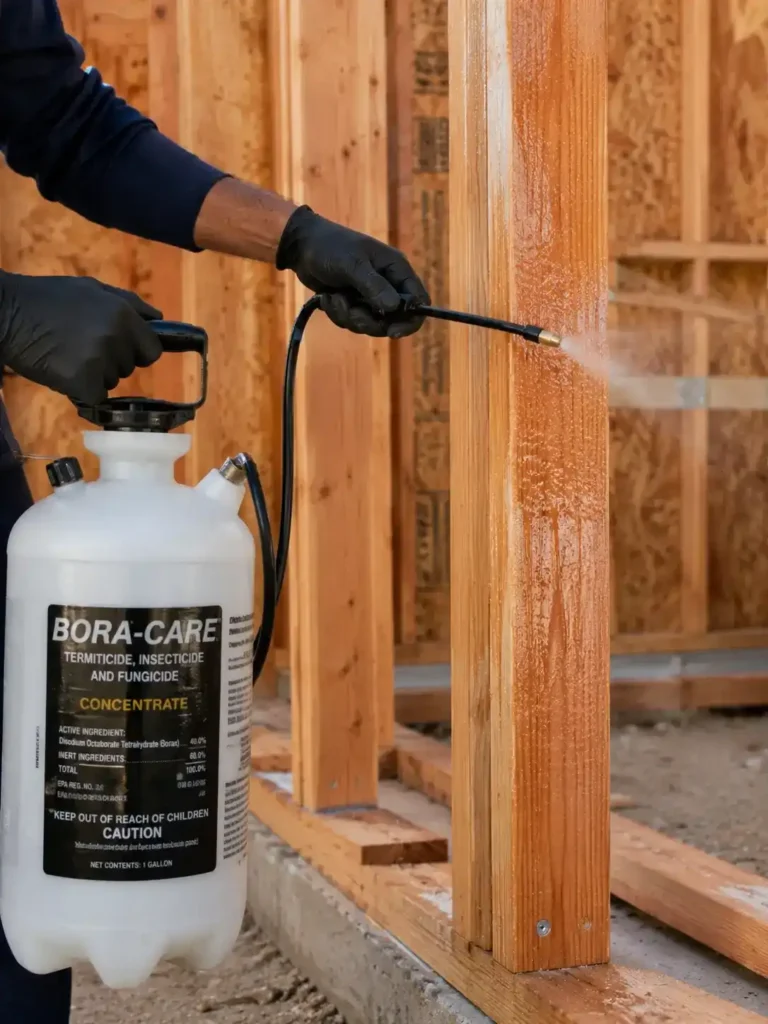
After the slab is poured and framing begins, a second phase of protection is available. All exposed framing lumber can be treated with a borate-based wood treatment like Bora-Care before insulation and drywall close off access. This includes sill plates, floor joists, and bottom plates. Bora-Care uses glycol penetrants to diffuse disodium octaborate deep into the wood. It remains in the wood for the life of the structure and kills any termites that attempt to feed on treated members. This phase is the last opportunity to protect the structural wood before it is sealed behind walls permanently. For builders pursuing California’s CalGreen certification or LEED points, borate wood treatment qualifies as an approved low-impact pest management strategy.
The third and final phase is the post-grading perimeter treatment. After landscaping grading is complete and the exterior soil profile is established, a final liquid termiticide application is made around the perimeter foundation. This refreshes the soil barrier at the exterior and addresses any gaps created by grading activities that disturbed the pre-pour treatment zone.
If any phase is skipped, the home enters service without the chemical barrier that makes subterranean termite interception possible. The most critical phase to never skip is the pre-pour soil treatment. Builders sometimes skip pre-treatment to reduce costs or due to scheduling pressure. In Sacramento’s Termite Infestation Probability Zone 1, homes built without pre-construction treatment can show evidence of subterranean termite activity within one to three years of occupancy, according to industry documentation.
HUD, FHA, and VA Requirements for New Construction in Sacramento
Pre-construction termite treatment is not optional for homes financed with FHA or VA loans. Federal requirements are specific and must be documented correctly for the loan to close.
HUD-NPMA-99A is the Subterranean Termite Protection Builder’s Guarantee. The builder signs this form to guarantee that termite protection was applied according to code-accepted methods. The builder also guarantees that if subterranean termite infestation occurs within one year of closing, the builder will arrange retreatment at no cost to the buyer. This is a legally binding commitment, not a courtesy.
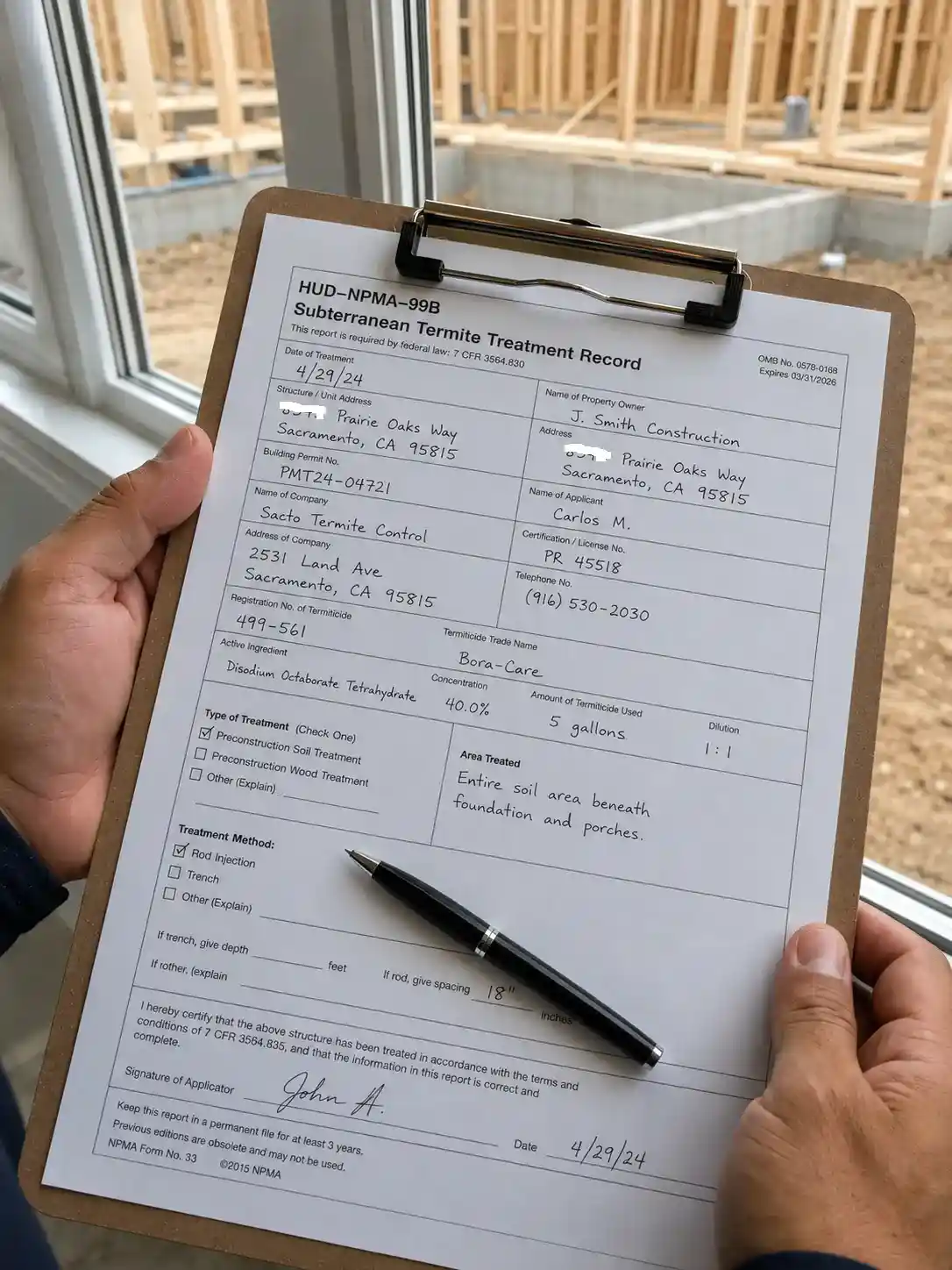
HUD-NPMA-99B is completed by the licensed pest control company and describes the specific treatments applied: soil applied liquid termiticide, wood applied liquid termiticide, bait system, or physical barrier system. Both forms are required for FHA-insured properties under 24 CFR Section 200.926d(b)(3), which requires HUD-insured sites to be free of termite hazards. VA loans follow the same requirements under VA Circular 26-14-33. The lender receives copies of both forms before closing.
We complete both forms accurately and on time, coordinating directly with your builder, lender, or escrow to ensure documentation is in order before the closing date. Delays in HUD-NPMA documentation are a common cause of closing delays on new construction loans. Getting the forms done correctly the first time protects your timeline.
Commercial new construction projects follow the same soil treatment protocol at a larger scale. This includes office buildings, retail developments, multi-unit residential buildings, and warehouses. We coordinate with general contractors and commercial lenders whose documentation requirements mirror or exceed FHA and VA residential standards.
What Builders and Homeowners Say About Our Pre-Construction Service
Verified feedback from residential builders and homeowners across the Sacramento Valley.
We built a custom home in Elk Grove and Sacto Termite coordinated the soil treatment directly with our foundation contractor. They were on site between the form work and the pour, completed the barrier application on schedule, and provided the treatment certificate the same day. Our lender accepted the documentation without any issues at closing.
As a general contractor building in the Roseville area, I have used Sacto Termite for pre-treatment on three residential projects. Their crew understands construction timelines and has never held up a pour. The treatment records are detailed, the chemical documentation is complete, and the inspector is available by phone when title companies have questions.
What Builders and Homeowners Should Verify Before Accepting Pre-Treatment Work
Pre-construction termite treatment is applied underground and inside wall cavities. Once the slab is poured and the walls are closed, there is no way to verify whether the treatment was done correctly without opening the structure. This creates a real risk that builders and homeowners need to understand before signing off on treatment work.
A pest control company can skip phases of the treatment without the builder or homeowner being able to detect it visually. The most common incomplete treatment scenario is skipping the final perimeter soil treatment after grading is complete. The pre-pour treatment was applied, but the post-grading treatment that addresses grading disturbance to the treated soil was not. The untreated soil created after grading becomes a pathway for subterranean termites to reach the foundation from the exterior.
To verify that treatment was completed correctly, request a signed treatment diagram showing exactly which soil zones and wood members were treated, what product was used, at what concentration, and at what volume per linear foot. This documentation should match the HUD-NPMA-99B form if FHA or VA financing is involved. Ask specifically whether all three phases were completed: pre-pour soil treatment, framing wood treatment, and post-grading perimeter treatment. A licensed pest control company that completed the work correctly has no reason to withhold this documentation.
We provide a complete signed treatment record with a site diagram after every pre-construction project. This record protects the builder from liability, satisfies lender documentation requirements, and gives the homeowner a verifiable record of what was done to protect their investment.
Frequent Questions About Pre-Construction Termite Treatment in Sacramento
Straight answers to what Sacramento homeowners ask most before calling us.
California Building Code Title 24 and the International Residential Code Section R318.1 both require termite protection for new construction in areas where subterranean termites are known to occur. Sacramento is in Termite Infestation Probability Zone 1, the highest risk designation under HUD. For homes financed with FHA or VA loans, pre-construction termite treatment is federally required and must be documented on HUD-NPMA-99A and 99B forms. For conventionally financed homes, the lender may not require it but local building departments in Sacramento County strongly recommend it. The cost of not treating is always higher than the cost of the treatment itself.
Some builders skip pre-construction treatment to reduce costs or because it adds a scheduling step that requires all other trades to pause during soil treatment. This is their choice on conventionally financed projects. However, the builder takes on legal liability for any termite infestation occurring within one year of closing on FHA and VA financed projects. If the builder signed an HUD-NPMA-99A without completing the actual treatment, that creates a legal exposure for both the builder and the homeowner. If your builder is resisting pre-treatment, ask them specifically whether the home is in Termite Infestation Probability Zone 1 and whether they will sign the HUD-NPMA-99A personally guaranteeing retreatment at their cost.
Not in the conventional sense. Once the slab is poured, the pre-pour soil treatment window is permanently closed. The soil beneath the slab cannot be treated without drilling through the concrete at multiple intervals, which is expensive, disruptive, and less effective than a pre-pour application. The framing wood treatment and post-grading perimeter treatment can still be done at their correct stages. If you are moving into a new home that was built without pre-pour treatment, a professional termite inspection after occupancy is the right first step. If subterranean termites are found, subterranean termite control through liquid barrier and slab injection is the post-construction solution.
Yes. We work with residential builders, custom home contractors, multi-unit residential developers, and commercial general contractors throughout Sacramento. Pre-construction termite treatment on commercial projects involves the same three-phase protocol but at larger scale, with more detailed site coordination and documentation requirements. We provide builder warranties, signed treatment diagrams, HUD-NPMA-99B forms for applicable projects, and post-treatment certificates that satisfy commercial lenders and building department requirements. Contact us at (916) 269-0582 to discuss scheduling and documentation requirements for your project.
We Provide Pre-Construction Treatment Throughout Sacramento and the Region
Our pre-construction termite treatment services cover following surrounding areas of Sacramento.
Elk Grove, Roseville, Folsom, Citrus Heights, Rancho Cordova, Carmichael, Fair Oaks, Rocklin, Davis, West Sacramento, Natomas, Galt, Woodland, Lincoln, Antelope, Orangevale, and Auburn.
Schedule an Urgent Inspection
Call (916) 269-0582 or email hello@sactotermitecontrol.com. We coordinate directly with your general contractor to schedule treatment at the correct construction stage. HUD-NPMA-99A and 99B documentation provided for FHA and VA financed projects. Free estimates provided.
- Licensed by the California Structural Pest Control Board
- HUD-NPMA-99A and 99B documentation completed
- Signed treatment diagrams provided on every project
- Residential and commercial construction served
- Builder and homeowner warranties available