When Is Termite Swarm Season in Sacramento?
Termite swarm season in the Sacramento Valley typically follows the region’s first warm days after winter rain, when reproductive termites leave an established colony to start new ones. Here’s what tends to trigger a swarm and what it means if you see one. What surprises many homeowners is that Sacramento has two distinct swarm seasons, one in spring and one in late summer, because two different termite species swarm here.
Sacramento Has Two Swarm Seasons, Not One
Most people picture a single spring swarm, but in the Sacramento Valley two termite species swarm at different times of the year. Subterranean termites, the most common species in our clay soils, swarm in spring, usually March through April, when the soil warms past 60 degrees after winter rain. Their winged reproductives often emerge indoors near windows and light sources, which is why spring swarm calls spike after the first warm, sunny stretch.
Drywood termites follow a different calendar. They swarm in late summer, typically August and September, when peak afternoon heat drives them out of attic framing, roof voids, and wall cavities. Drywood swarms are smaller and easier to miss. Many homeowners never see the insects at all, only the shed wings left behind on windowsills.
At Certified Termite Inspection Company in Sacramento, we treat both species every year, and the treatment for each is completely different, which is why identifying which swarmer you saw matters.
|
Species |
Typical swarm window |
Where you will notice them |
What it signals |
|---|---|---|---|
|
Subterranean termites |
March to April |
Indoors near windows and lights, or around foundations |
A mature colony in the soil nearby, possibly under your home |
|
Drywood termites |
August to September |
Attic vents, windowsills, small piles of shed wings |
A colony inside your home’s wood, often in the attic or walls |
What a Spring Swarm Tells You About Your Home
Swarming is typically triggered by a combination of warmth and moisture, which is why it tends to follow the first stretch of warm, sunny days after a period of rain, most commonly in spring in this region. Exact timing varies year to year with the weather rather than falling on a fixed calendar date.
A swarm means a colony nearby has matured enough to reproduce, which is worth taking seriously even though the swarmers themselves are relatively harmless. Seeing swarmers inside your home specifically, as opposed to outside in the yard, is a stronger signal that the colony may already be in the structure.
We respond to swarm-related calls across Sacramento, Elk Grove, Roseville, and Folsom every year during this stretch of the season.
If you’ve seen a swarm, especially indoors, the next step is confirming the species and applying the right termite treatment. Subterranean colonies are eliminated with liquid barriers or bait systems, while drywood colonies call for targeted spot treatment or full fumigation. Matching the method to the species is what ends the infestation the first time.
What to Do If You See a Swarm
Note where you saw it, indoors or outdoors, and roughly how many termites were involved, then schedule an inspection to check for a nearby or established colony. Swarmers themselves don’t cause damage, but they’re a signal worth acting on.
Our termite inspection service can determine whether a swarm you’ve seen points to an active colony on your property.
Termite Swarmers vs Flying Ants: How to Tell Them Apart
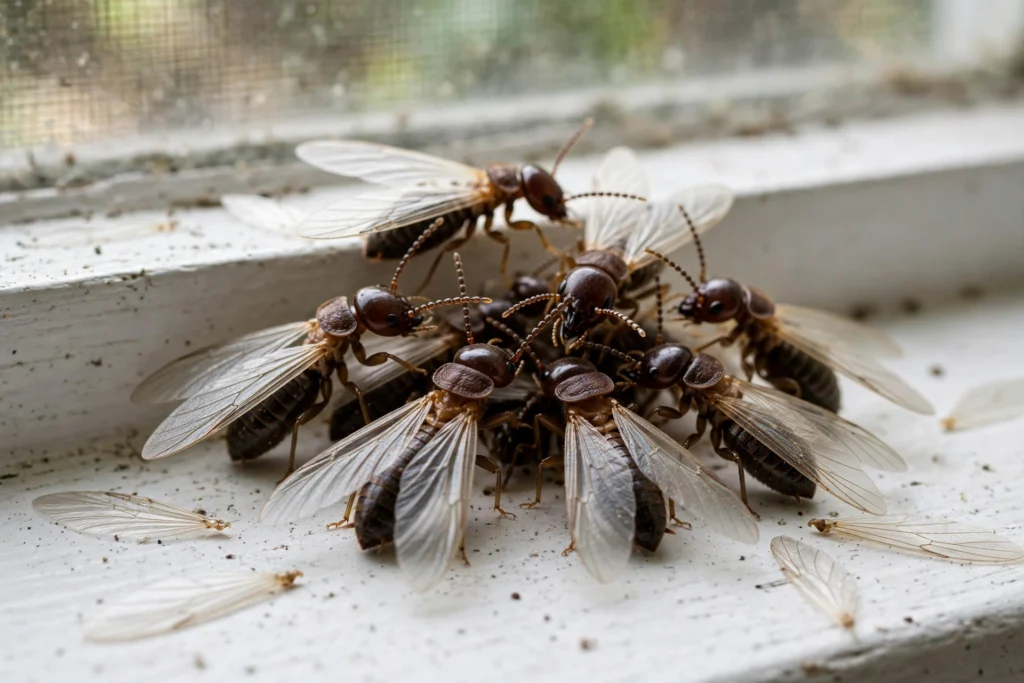
Not every winged insect in spring is a termite. Flying ants swarm in Sacramento too, and the two are easy to confuse at a glance. Three details settle it:
- Wings: termite swarmers have two pairs of wings that are equal in length and extend well past the body. Flying ants have front wings noticeably longer than their hind wings.
- Antennae: termites have straight, beaded antennae. Ants have distinctly elbowed antennae.
- Waist: termites have a thick, uniform waist. Ants have a narrow, pinched waist.
The photo above shows true termite swarmers. If what you saw matches, treat it as a termite signal and get an inspection.
Frequent Questions About Termite Swarm Season
Real questions homeowners ask about termite swarming in the Sacramento area.
Subterranean termites swarm in spring, usually March through April, after the first warm stretch following winter rain. Drywood termites swarm later, in August and September, when peak heat pushes them out of attics and wall voids. Timing shifts with the weather year to year, so swarmers outside these windows still deserve a professional look.
No, swarmers don’t bite or cause damage themselves, but their presence usually signals a mature colony nearby that’s worth having checked.
Not necessarily. Swarmers outdoors can come from a colony elsewhere in the area, while swarmers found indoors are a stronger sign the colony may already be in your home.
Note where you saw them, indoors or outdoors, and roughly how many. If you can, trap a few in a jar for identification. Then schedule an inspection. Our termite inspections are free, and a technician will confirm whether the swarm points to an active colony in your home and what treatment, if any, is needed.